For example ,0-simplex is a point, 1-simplex ⟨p0p1⟩ is an edge, ⟨p0p1p2⟩ is a triangle with its interior included, 3-simplex is a solid tetrahedron. (c0,…,cr) is called barycentric coordinate of x. Since σr is bounded and closed subset of Rm, it is compact.
Let q≤r a nonnegative integer. We choose q+1 points out of p0,…,pr, define a q-simplex σq=⟨pi0…piq⟩, which is called q-face of σr. Write σq≤σr if σq is a face of σr, and moreover a proper face of σr if σq=σr.
The number of q-faces of an r-simplex is (q+1r+1)
2.2 Simplicial complexes, polyhedra
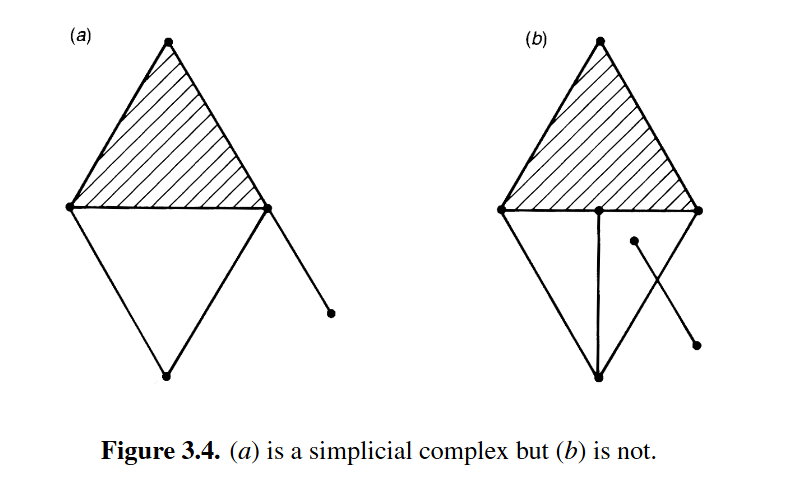
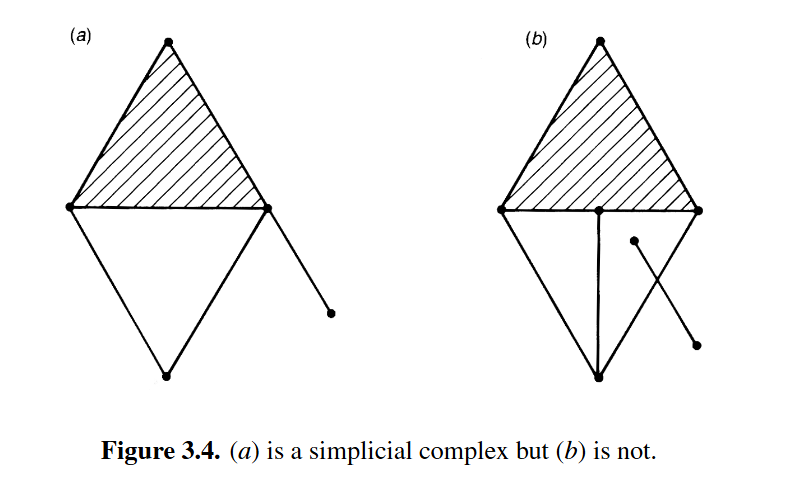
Let K be a set of finite number of simplexes in Rm. If these simplexes are nicely fitted together, K is a simplicial complex. By nicely we mean:
if σ∈K, σ′≤σ, then σ′∈K
if σ,σ′∈K, then either σ∩σ′=∅ or σ∩σ′≤σ,σ∩σ′≤σ′ dimK is the largest dimension of its simplexes. \fcolorbox{green}{}{Example}
σr is a r-simplex and K={σ′∣σ′≤σr} be the set of faces of σr. K is an r-dimensional simplical complex.
\fcolorbox{green}{}{End Example}
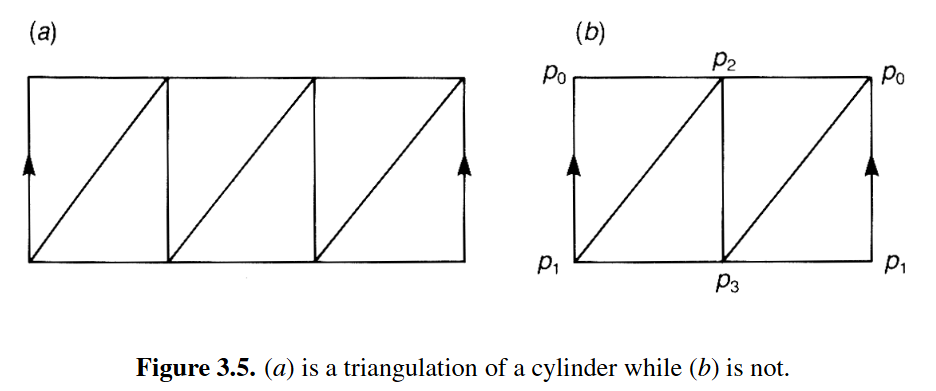
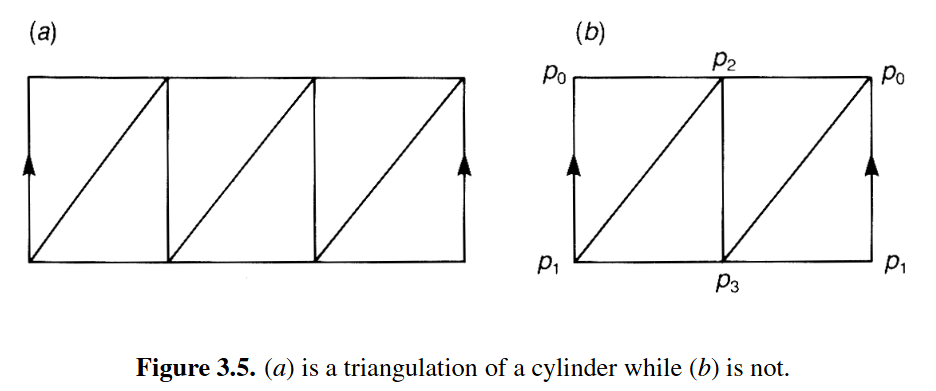
Polyhedron: ∣K∣=⋃σ∈Kσ is called polyhedron of simplicial complex K. The dimension of ∣K∣ is the same with K: dim∣K∣=dimK Let K be a topological space. If there exists a simplicial complex K and a homeomorphism f:∣K∣→X, X is triangulable and the pair (K,f) is triangulation of X.
Homology groups of simplicial complexes
3.1 Oriented Simplexes
Assign an orientation to an r-simplex for r≥1. Use (…) for an oriented simplex. (p0p1) is a directed line segment from p0 to p1. (p1p0)=−(p0p1). Similarly, for σ2=(p0p1p2) is a triangular rigion with a prescribed orientation along the edges. Any swap of the points produces a -1:
(pipjpk)=sgn(P)(p0p1p2)
More generally, for r-simplex, select a permutation P∈Sr+1, we have that
(pP(0)…pP(r))=sgn(P)(p0p1…pr)
3.2 Chain group, cycle group, boundary group
Let K={σα} be an n-dimensional simplical complex. We regard σα as orinted, denote by σα as before.
(Cr(K)) The r−chain group Cr(K) is a free Abelian group generated by oriented r-simplexes of K. Cr(K)=0 if r>dimK. An element of Cr(K) is called r-chain. Let Ir be number of r-simplexes in K. ∀c∈Cr(K),
c=i=1∑Irciσr,ici∈Z
Addition of r-chains:
c+c′=i∑(ci+ci′)σr,i
We see that Cr(K) is a free Abelian group of rank Ir, Cr(K)≅ZIr
boundary operator is a map ∂r:Cr(K)→Cr−1(K) satisfying that for r-simplex σr=(p0…pr),
∂r(p0p1…pr)=i=0∑r(−)i(p0p1…p^i…pr)
where p^i is omitted. ∂r is linear.
∂0p0=0
∂1(p0p1)=p1−p0
∂2(p0p1p2)=(p1p2)−(p0p2)+(p0p1)
It is easy to see the boundary operator is a homomorphism. There is a sequence of free Abelian groups and homomorphisms
0→iCn(K)→∂nCn−1(K)→…→∂1C0(K)→∂00
where i:0→Cn(K) is an inclusion map, 0 is regarded as unit element of Cn(K)
(Zr(K)) If c∈Cr(K), ∂rc=0, then c is an r-cycle. Define Zr(K) to be the set of all r-cycles:
Zr(K)={c∣c is an r-cycle}=ker ∂r
(Br(K)): If c∈Cr(K), ∃d∈Cr+1(K) such that c=∂r+1d, then c is called r-boundary. Br(K) is the r-boundary group, Br(K)=Im∂r+1
\fcolorbox{pink}{}{Lemma 3.3}∂r∘∂r+1 is a zero map, ∂r∂r+1c=0 for any c∈Cr+1(K) \fcolorbox{pink}{}{End Lemma} You can prove the lemma by calculating ∂r∂r+1c directly for some given c. This means that Br(K)⊂Zr(K), or Im∂r+1⊂ker∂r.
3.3 Homology groups are topological invariants
We have defined 3 groups, how are they related to topological properties of K or to the topological space whose triangularization is K? Clearly Cr(K) is not conserved under homeomorphism: If K is a triangle, C1(K)≅Z3; for square C1(K)≅Z4.
Define Hr(K)=Zr(K)/Br(K) is the rth homology group. Use Hr(K;F) for definition of different field of coefficients.
Since Br(K) is a subgroup of Zr(K),
Hr(K)≡{[z]∣z∈Zr(K)}
where [z] denotes equivalence classes(homology class). z∼z′ iff z−z′∈Br(K)
Homology groups are topological invariants: Let X be homeomorphic to Y, let (K,f),(L,g) be triangulations of X,Y respectively. Then
Hr(K)≅Hr(L),r=0,1,2,…
In particular, if (K,f) and (L,g) are to particular triangulation of X, then
Hr(K)≅Hr(L),r=0,1,2,…
(We are using = as ≅)
Let K={p0}, C0(K)={ip0∣i∈Z}≅Z, Z0(K)=C0(K),B0(K)={0}
K={p0,p1}, H0(K)=Z2, Hr(K)={0},r≥1
K={p0,p1,(p0p1)}, Z0=C0≅Z2,Z1={0},B0={i(p1−p0)∣i∈Z}≅Z1, B1={0}, So H0≅Z,H1={0}
K={p0,p1,p2,(p0p1),(p1p2),(p2p0)}, Z0=Z4,Z1=Z1,B0=Z3,B1=Z0, H1=H0=Z ( triangulation of S1)
K={p0,p1,p2,p3,(p0p1),(p1p2),(p2p3),(p3p0)}, H1=H0=Z (triangulation of S1)
K={p0,p1,p2,(p0p1),(p1p2),(p2p0),(p0p1p2)}, First H0≅Z. Z1={i[(p0p1)+(p1p2)+(p2p0)∣i∈Z], if b=∂2c, c=m(p0p1p2), we have b=m[(p0p1)+(p1p2)+(p2p0)], so H1≅{0}. Moreover H2≅{0}
K={p0,p1,p2,p3,(p0p1),(p0p2),(p0p3),(p1p2),(p1p3),(p2p3),(p0p1p2),(p0p1p3),(p0p2p3),(p1p2p3)} be a simplical complex of a tetrahedron( triangulation of S2). H0=Z,H1={0},H2=Z where we have used Hr:=Hr(K), etc.
3.4 Computation of H0
Let K be a connected simplicial complex, then H0≅Z
3.5 More homology computations
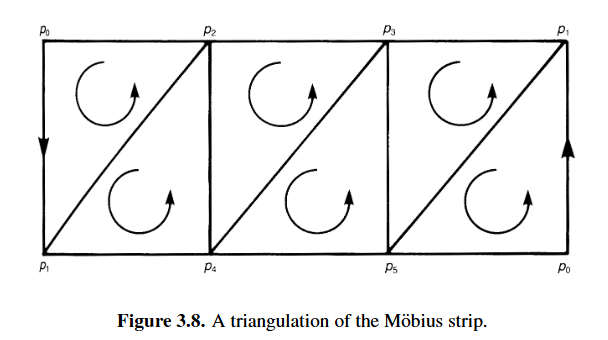
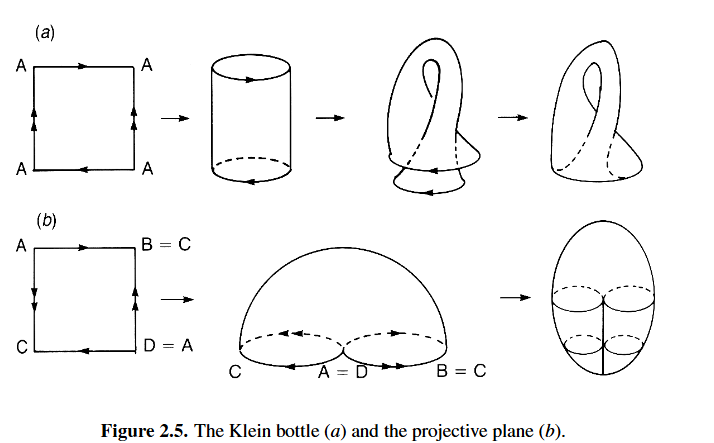
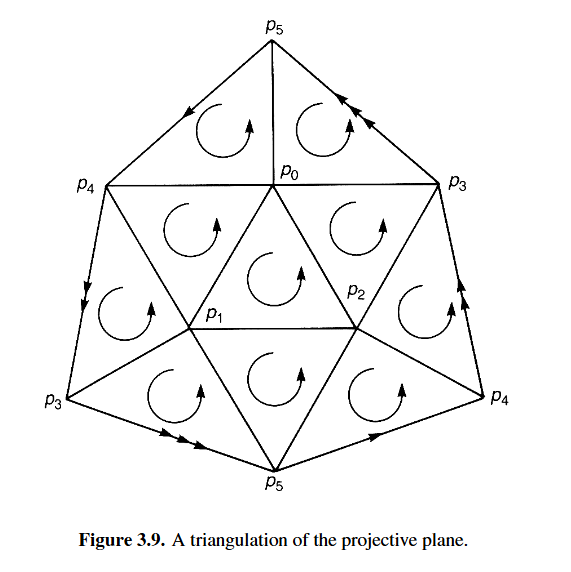
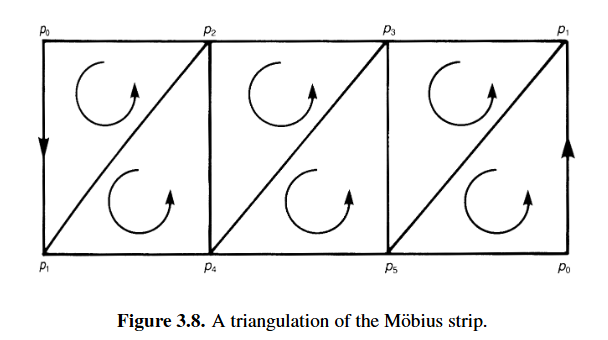
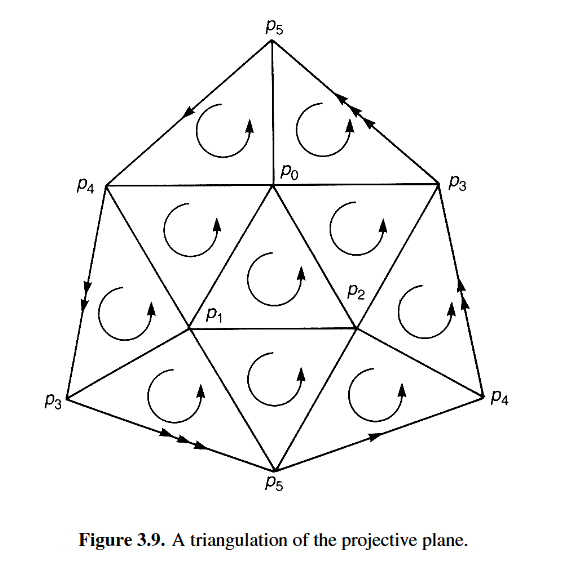
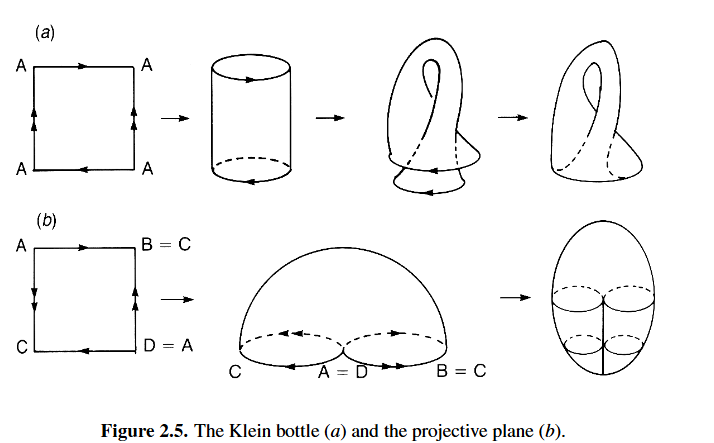
The triangulation of Mobius strip. We can verify that H1(K)≅Z, H2(K)={0}, H0(K)≅Z for being connected. The triangulation of RP2, defined as S2 where antipodal points identified. By calculating ∂2z=0 with z=∑imiΔ2i, where Δ2i being all 2 simplexes, we find that Z2(K) is trivial, H2(K)={0}. Consider z=∑imΔ2,i∂2z=2m(p3p5)+2m(p5p4)+2m(p4p3), so if z∈Z2(K), m=0, so Z2(K)={0}. Note that any cycle is homologous to nz, with z=(p3p5)+(p5p4)+(p4p3). Furthermore, even multiple of z is a boundary of 2-chain. Thus z is a cycle and z+z is homologous to 0. Hence we find that
H1(K)={[z]∣[z]+[z]∼[0]}≅Z2
This shows that a homology group is not necessarily free Abelian but may have the full structure of a finitely generated Abelian group.
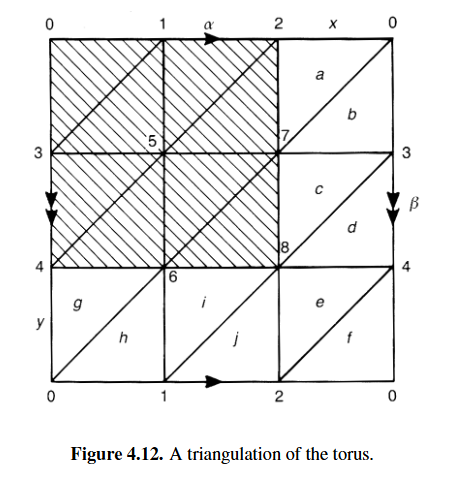
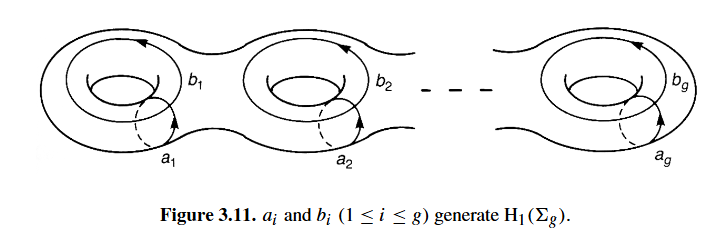
Consider T2 torus. r-th homology group is generated by boundaryless r-chains that are not boundaries of r+1 chains. For example, the surface of torus has no boundary but it is not boundary of some 3-chain. Thus H2(T2) is freely generated by 1 generator(the surface itself), H2(T2)≅Z.
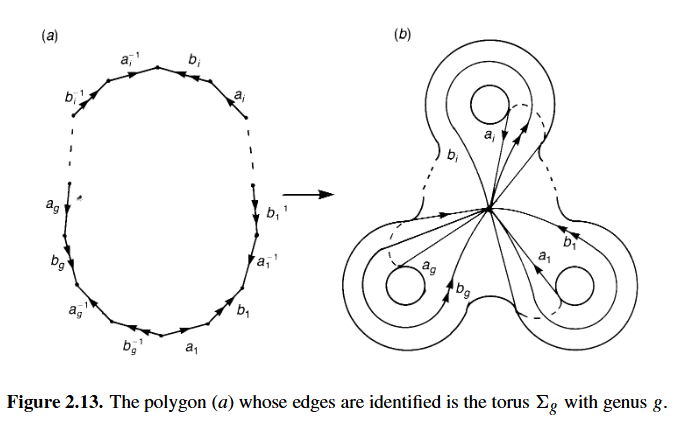
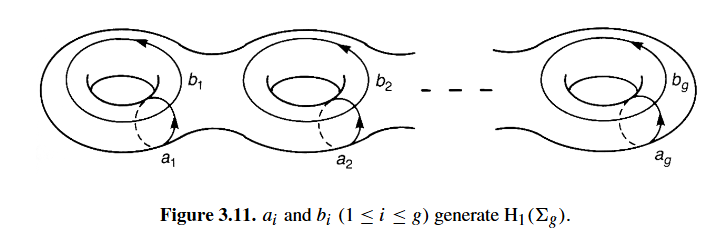
Look at H1(T2). Two loops a,b have no boundaries but are not boundaries of some 2-chains. Take another loop a′, a′ is homologous to a since a′−a=∂2s for some s. So H1(T2) is freely generated by a,b, H1(T2)≅Z2. H0(T2)≅Z for T2 connected. Then generalizing the analysis to Σg. Since Σg has no boundary and there are no 3-simplexes, the surface itself freely generates H2(Σg)≅Z. There are 2g independent paths, so H1(Σg)≅Z2g. H0(Σg)=Z since it is connected.
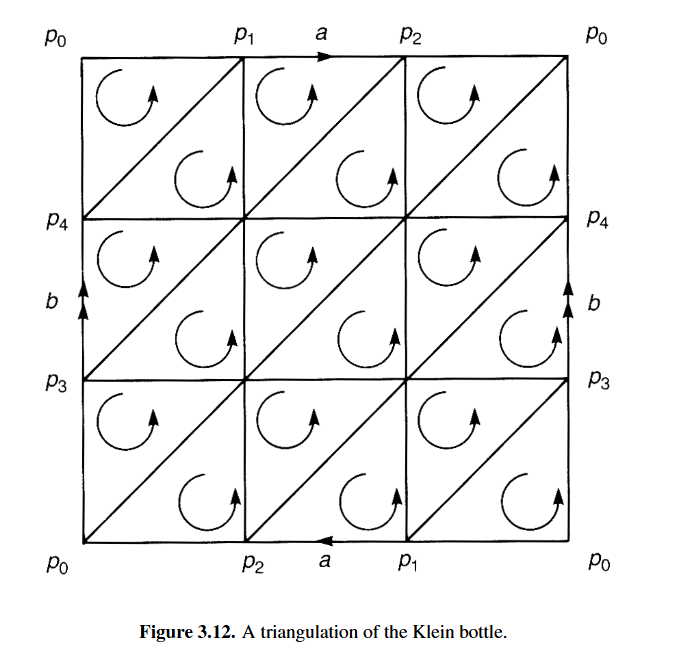
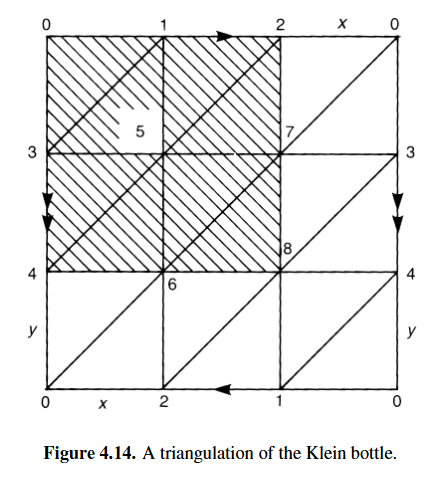
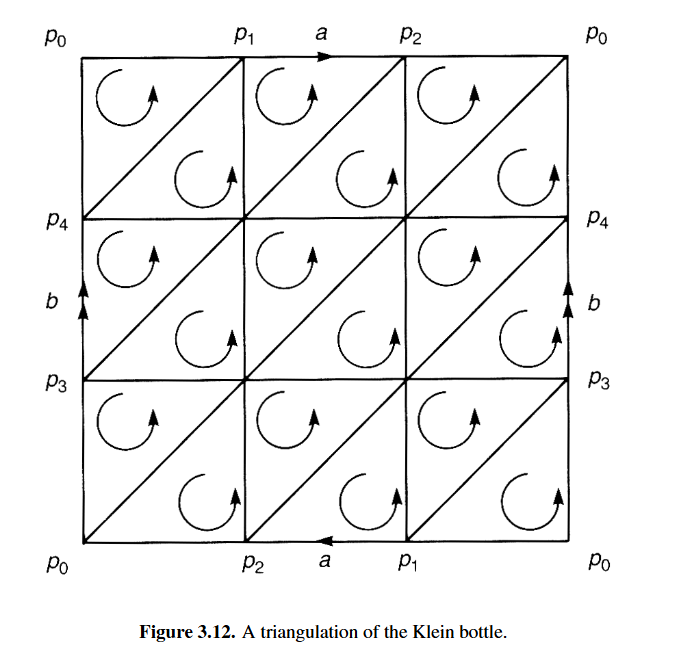
For Klein bottles, let z=∑imσ2,i∈Z2(K), ∂2z=−2ma, a=(p0p1)+(p1p2)+(p2p0). so ker∂2=Z2=H2={0}; for H1, we have that each 1-cycle is homologous to ia+jb,i,j∈Z. For a 2-chain to have a boundary consisting a,b only, all 2-simplex in K must be added with the same coefficient. for such a 2-chain z=∑imσ2,i, ∂z=2ma. this shows that 2ma∼0. Thus H1 is generated by two cycles a,b such that a+a=0, namely
H1(K)={i[a]+j[b]∣i,j∈Z}≅Z2⊕Z
3.4 General properties
1. Connectedness
Let K be a disjoint union of N connected components, K=K1∪K2⋯∪KN, Ki∩Kj=∅, then
Hr(K)=i=1⨁NHr(Ki)
So is true for $C_{r}(K)$, $Z_{r}(K)$ and $B_{r}(K)$
One corollary is that for disjoint union of N connected components H0(K)≅ZN
2. Structure
The most general form of Hr(K) is
Hr(K)≅fZ⊕⋯⊕Z⊕Zk1⊕⋯⊕Zkp
From our experience Hr(K) counts the number of (r+1)-d holes in ∣K∣. The first part is free and the last p part are called torsion subgroup. Projective plane has H1(K)≅Z2, Klein bottle H1(K)≅Z⊕Z2. The torsion subgroup detects the twisting in polyhedron ∣K∣ in a sense. We can now clarify why use Z coefficients for homology groups instead of Z2 or R. Since Z2 has no non-trivial subgroups, and R will make us not see the torsion subgroup, since R/mR≅{0} for any m∈Z−{0}. If Hr(K;Z) is given by above, Hr(K;R)≅Rf.
3. Betti numbers, Euler-Poincare theorem
The r-th Betti number br(K) is defined as
br(K)≡dimHr(K;R)
Or the free abelian part of Hr(K;Z)
For example, K=T2, bi(K)=1,2,1 for i=0,1,2 bi(S2)=1,0,1 for i=0,1,2
Let K be an n-dimensional simplicial complex and Ir the number of r-simplexes in K. Then
χ(K)≡r=0∑n(−)rIr=r=0∑nbr(K)
The first equality defines the Euler characteristic of general polyhedron ∣K∣. This is the generalization of Euler characteristic defind on surfaces.


Leave a Comment